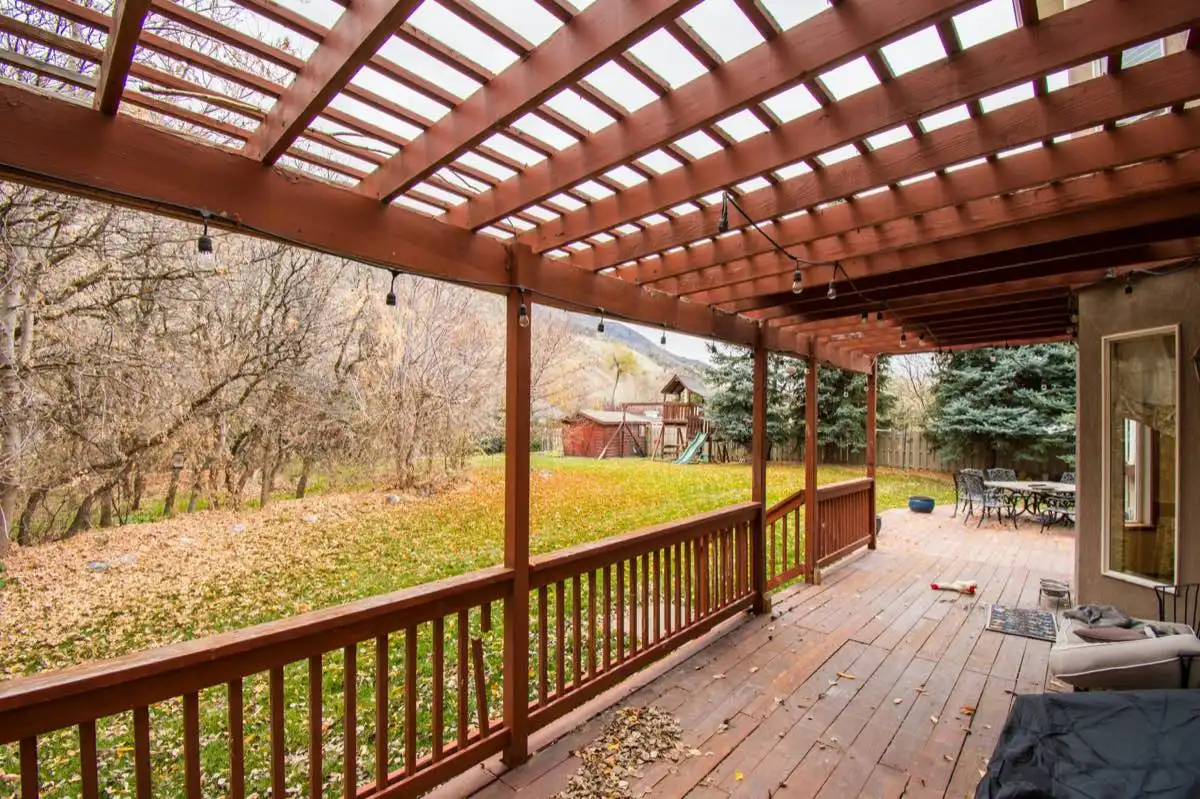
Good patio cover lighting is three layers — ambient, task and accent — not one bright fixture in the middle of the ceiling. That single fixture is why so many covered patios feel like a parking structure after dark: everyone lit from directly overhead, harsh shadows under the eyes, the general mood of a mild interrogation.
Fix that and the space doubles in usable hours. The good news is that most of the fix is cheap, and one whole layer of it needs no electrician at all.
The three layers, and what each one does
Ambient is the general fill that lets you see the space. Recessed cans, flush-mounts, or a couple of well-placed surface fixtures. This layer should be dimmable and it should be warm — around 2700K. Cool white outdoors after dark reads as a loading dock.
Task is light aimed at something you're doing. The grill, a prep counter, the steps down to the yard, the table when someone's actually eating rather than lounging. Slightly brighter, and it can run around 3000K without wrecking the mood.
Accent is the layer that makes people say the patio looks nice without being able to say why. Uplights on a post, a strip washing the underside of a beam, string lights swagged across the opening, a sconce by the door. It's the cheapest layer and it does the most emotional work.
The rule of thumb worth stealing: if you can see the bulb from a seated position, it's the wrong fixture or the wrong place. Light the surfaces, not the eyes.
Fixture types, ranked by how much trouble they are
- Low-voltage 12V string and landscape lighting. Cheapest, easiest, and genuinely DIY. Runs off a transformer plugged into an existing exterior receptacle.
- Surface-mount and flush-mount fixtures. Straightforward on a beam, a fascia or a wall. Needs a hardwired box.
- Wall sconces. Great for a cover attached to the house, since the wall is already there and often already has a box.
- Linear LED strip in an aluminum channel. Tucked into a beam edge or fascia, this gives that clean indirect glow. Use an outdoor-rated strip with a real IP rating and a proper driver, not the peel-and-stick tape from a big box.
- Recessed cans in the roof panel. The cleanest look and the most work. In a solid or foam-core panel, the panel has to be drilled and a wire chase run, which is exactly why cans cost more than a surface mount and why they need to be planned before the panels go up.
- Pendants over a dining table. Lovely, and the first thing to swing in wind. Fine under a fully protected cover, questionable on an exposed corner.
The code details that actually matter
None of this is exotic, but skipping it is how a nice patio becomes a warranty argument.
Wet vs damp location. Fixtures need a UL 1598 listing appropriate to their exposure. Damp-location is for spots that are covered and protected from direct water. Wet-location is for anywhere wind-driven rain can reach — which on an open-sided patio is more of the ceiling than people assume, particularly the outer three or four feet.
GFCI on outdoor receptacles, per NEC 210.8. Not optional, not a formality.
In-use covers, per NEC 406.9. These are the bubble-style covers that keep a receptacle protected while a cord is plugged in. The flip-lid kind that only seals when empty doesn't meet the requirement on an exterior receptacle.
Fan-rated boxes. A ceiling fan needs a box listed for fan support, plus a damp or wet-location rating on the fan itself. A standard lighting box was never designed for a wobbling 20-pound object with rotational load, and it will eventually make that clear.
Electrical pulls its own permit in most jurisdictions, separate from the structural permit for the cover, with its own inspection. The patio cover permits guide has the fuller picture on how those stack.
Plan the wiring before the roof goes on
This is the part that costs people money, and it costs it silently.
Running conduit and boxes while the frame is open is fast. Running them after a solid or insulated foam-core roof is buttoned up means drilling a finished panel, fishing a chase, and patching. It's doable and it's several times the labor.
So before install day, mark on a sketch: where the table goes, where the grill goes, where a fan would hang, whether a TV is in your future, and where the switch should live so you're not walking across the patio in the dark to turn on the light that would have shown you where you were walking. Add one more receptacle than you think you need. Nobody in the history of covered patios has complained about a spare outlet.
When to skip the electrician entirely
Here's the honest one. If you have an existing covered patio and an existing exterior outlet, low-voltage 12V string and landscape lighting will transform the space for a couple hundred dollars, in an afternoon, with no electrician and no permit.
A transformer, a run of 12-gauge low-voltage cable, some warm-white string lights swagged along the beams, and maybe two small uplights on the posts. Twelve volts is not a shock hazard the way line voltage is, the connectors are designed for outdoor use, and if you get the layout wrong you just move it. Most patios that feel dim don't need a rewire — they need $200 of string light and a dimmer.
Hire the electrician when you want recessed cans in the panel, a ceiling fan, new circuits, or added receptacles. That's real work and it's inspected work.
The one opinion, held firmly
A ceiling fan does more for a covered patio than any lighting upgrade, and it should be the first hardwired thing you buy. Light makes the space usable after dark; a fan makes it usable at all in heat, and moving air is also the single most effective mosquito deterrent that doesn't involve chemicals — most biting insects are weak fliers and simply give up. A decent damp-rated fan plus proper installation costs less than a set of recessed cans, and you'll notice it every single evening. Buy the fan, then buy the pretty lights.
Bottom line
Layer it: warm dimmable ambient, task light where you actually do things, accent light for the mood. Use fixtures rated for their real exposure, GFCI and in-use covers on the receptacles, a fan-rated box for the fan. Rough in the wiring while the frame is open. And if all you need is atmosphere, buy string lights and keep your money.
Brownsville Elite Patio Covers builds insulated patio covers, patio enclosures and aluminum covers across Brownsville and the Brownsville area, with lighting, fans and circuits planned into the structure instead of chased in afterward. Bring us a sketch of where the table goes and we'll take it from there. Call (844) 719-4348.
Ready for a free quote in Brownsville?
Brownsville Elite Patio Covers — free estimate, clear scope, no pressure. Use the form on this page or jump to the homepage quote.
Related services in Brownsville
Brownsville Elite Patio Covers money pages — go straight to the service you need.
- Insulated Patio Covers →
An insulated panel is two roll-formed aluminum skins bonded to an expanded polystyrene core, and the core is carrying load rather than filling space. It ties the two skins together so the assembly acts as one section, which is why the roof spans from the house wall to the front beam with no joists under it.
- Aluminum Patio Covers →
Extruded aluminum earns its place here for unglamorous reasons. It does not rot, termites have no use for it, and it shrugs off a humidity swing that would move timber.
- Sunrooms & Patio Enclosures →
Glazing in a patio changes its legal identity, and that is the first thing to establish. IRC Appendix AH requires the longer wall and one additional wall to be at least 65 percent open or glazed below 6 feet 8 inches.
- Alumawood & Composite Covers →
Woodgrain composite covers are roll-formed aluminum with an embossed texture and a baked-on finish over hollow sections. From the seating area it reads as stained timber.
- Wood Patio Covers →
Timber is still the warmest thing you can build over a patio, and the case against it in Brownsville is not aesthetic. It is chemistry.
Frequently asked questions
What kind of lights can you put under a patio cover?
Recessed cans, surface-mounted or flush-mount fixtures, linear LED strip in a channel, wall sconces, hanging pendants over a table, and low-voltage string lights. The important part is the listing: anything under an open-sided cover generally needs at least a damp-location rating under UL 1598, and a wet-location rating where wind-driven rain can reach it.
Can you put recessed lights in an insulated patio cover?
Yes, but the panel has to be drilled and a wire chase run through or above it, which is why cans cost more to install than a surface-mounted fixture. Foam-core panels also need fixtures suited to being buried in insulation. Plan the layout before the panels go up and the job is straightforward; do it afterward and you're cutting into a finished roof.
Do outdoor patio outlets need GFCI?
Yes. NEC 210.8 requires GFCI protection for outdoor receptacles, and NEC 406.9 requires an in-use weatherproof cover on exterior receptacles — the bubble style that stays protective while a cord is plugged in, not the flip lid that only closes when nothing is. These are the two details a DIY install most often misses.
What rating does a patio ceiling fan need?
A damp-location fan under a fully covered, protected patio, and a wet-location fan where rain can blow in. Either way it must hang from a listed fan-rated box, because a standard lighting box is not built for the dynamic load of a spinning fan. Indoor fans on a patio warp, rust and drop blades sooner than you'd think.
Do I need an electrician for patio string lights?
Not for plug-in string lights or a low-voltage 12V system running off a transformer plugged into an existing exterior outlet. That's a genuine afternoon project and generally needs no permit. New circuits, hardwired fixtures, added receptacles and ceiling fans are different and typically pull an electrical permit with an inspection.
What color temperature is best for patio lighting?
Warm light in the 2700K range for anywhere people relax, since cooler light outdoors reads as institutional after dark. Task areas like a grill or prep counter can run a little brighter and cooler, around 3000K, without breaking the mood. Mixing wildly different color temperatures in one ceiling is the most common thing that makes a nice patio look off.
How much does patio cover lighting cost?
Low-voltage string lighting can be done for a couple hundred dollars. A hardwired package with a few recessed cans, a fan and switching typically runs from several hundred to a few thousand installed, depending on how far the circuit has to travel and whether panels have to be drilled. Running it during the cover install is always cheaper than adding it later.
Local context
How this applies in Brownsville, TX
Every article here is written from patio cover work done in Brownsville and the Brownsville area, so the numbers reflect local labour, permit and material costs rather than a national average. Your own job can land either side of them depending on access, the condition of what is already there, and the materials you pick — insulated foam-core roof panels, W-pan and flat-pan aluminum roofing, powder-coated extruded aluminum.
The way to turn any of this into a real answer is to have someone look at your actual situation. The free estimate is free, itemized and written down, with no deposit and no obligation. Call (844) 719-4348 or start on the Brownsville Elite Patio Covers homepage.
Areas Brownsville Elite Patio Covers covers
Brownsville first, then the surrounding communities of the Brownsville area. Each has its own page with local detail rather than a copy of this one:
- Harlingen, TX — Cameron County, incorporated in 1910, population 71,829 at the 2020 census
- San Benito, TX — Cameron County, incorporated in 1911, population 24,861 at the 2020 census
- Los Fresnos, TX — Cameron County, population 8,114 at the 2020 census
- Port Isabel, TX — Cameron County, incorporated in 1928, population 5,028 at the 2020 census
- South Padre Island, TX — Cameron County, incorporated in 1973, population 2,066 at the 2020 census
- Laguna Vista, TX — Cameron County, population 3,520 at the 2020 census
Or jump to the full list of Brownsville services.
More from the Brownsville Elite Patio Covers blog
- Outdoor Kitchen Patio Cover Planning for Brownsville
Putting a grill under a patio cover is a clearance and ventilation problem first. How to plan it safely on a Brownsville, TX patio, and what it costs.
- Lattice vs Solid Patio Cover: Brownsville Shade Guide
Lattice gives roughly 40 to 70 percent shade and no rain protection; solid gives 100 percent of both. Here's how to choose for a Brownsville, TX patio.
- Alumawood Patio Cover in Brownsville: What You Get
Alumawood is embossed, powder-coated aluminum built to look like painted wood. Here's how it really performs on a Brownsville, TX patio, dents and all.
The Brownsville Elite Patio Covers Team
patio cover specialists serving Brownsville, TX
Written by the Brownsville Elite Patio Covers team — insured patio cover pros with 15+ years serving Brownsville, TX and the surrounding area.